
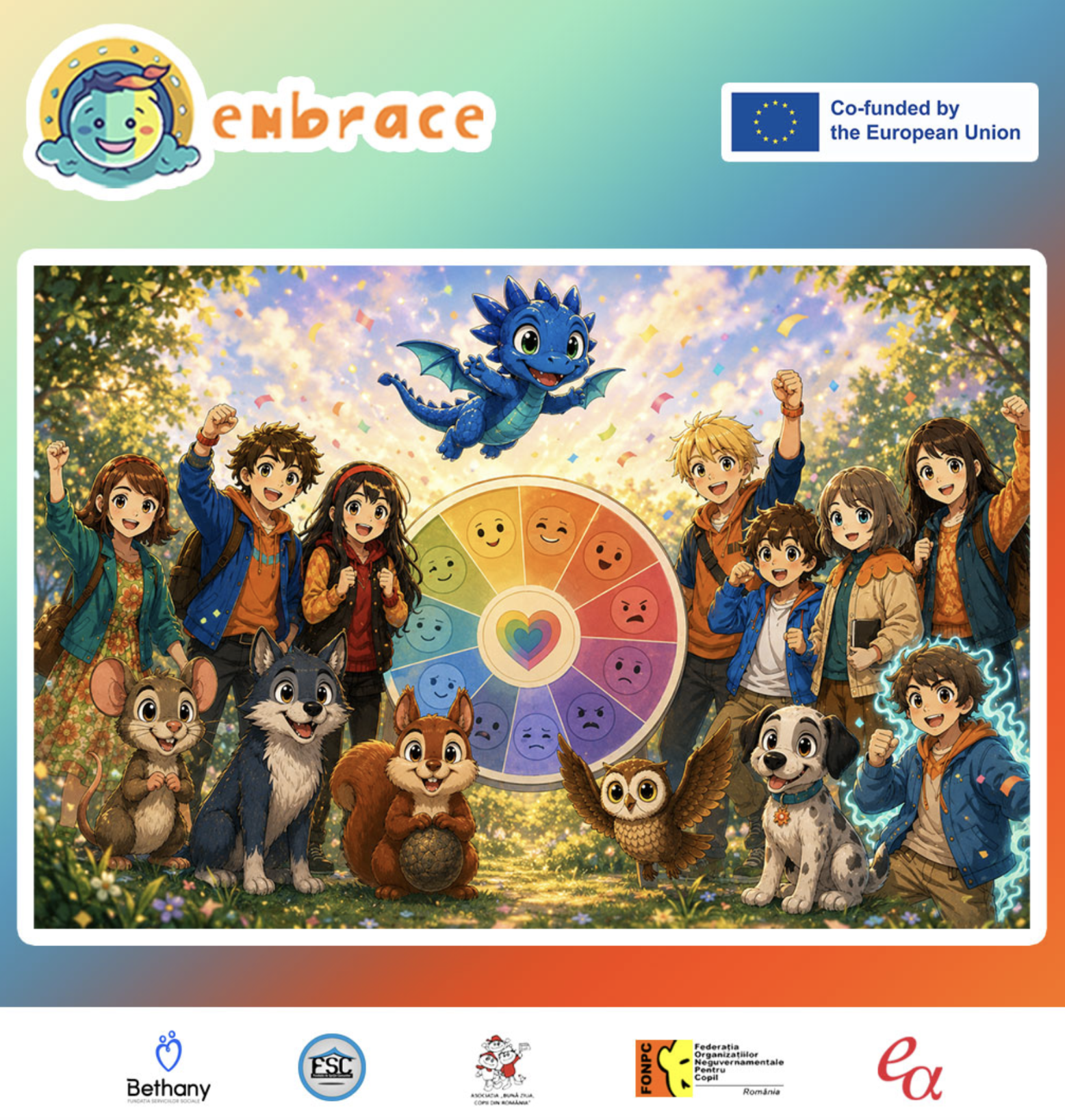
IAșI, ROMANIA, July 9, 2026 / EINPresswire.com / -- Romania is facing a reality that data confirms and practice lives daily: the system is not prepared to respond to the mental health needs of children. According to UNICEF Romania, 1 in 4 students is at risk of suffering from a mental health problem, a third
report frequent anxiety, and 1 in 4 have thoughts or behaviors of self-harm. In this context, the EMBRACE project - Empower and Build Resilience at Children - set out to build a concrete, tested and scalable response: a school intervention model for the emotional well-being of children from vulnerable communities in the North-East region of Romania.18 months. A consortium. A model.
Implemented between January 2025 and June 2026, with a budget of €465,667.67 funded by the European Commission through the CERV-CHILD 2024 program, the EMBRACE project was coordinated by the Bethany Social Services Foundation (FSSB) https://bethany.ro/ , the Community Support Foundation (FSC) https://fsc.ro/ , the “Bună Ziua, Copii din România” Association (BZRO) https://www.bunaziuacopii.ro/ , the Federation of Non-Governmental Organizations for Children (FONPC) https://fonpc.ro/ and Evolutionary Archetypes Consulting SL (EAC), (Spain) https://ea.consulting/ , with the support of associated partners: ISJ Iași and Vaslui, CJRAE Iași and Vaslui, DGASPC Bacău, local authorities from the pilot communities and the 10 pilot schools from Iași, Bacău and Vaslui counties.
During the 18 months of implementation, the project developed and tested a curriculum structured on five modules dedicated to emotional well-being: physical health, cognitive well-being, emotion management, values and identity, relationships and social integration, with 15 sessions adapted for each school level: primary (6-10 years), middle school (11-14 years) and high school (15-18 years).
The program's impact figures:
● 528 children successively completed the 5 modules, in 10 schools in small urban and rural communities;
● 374 parents involved in emotional literacy sessions;
● 140 specialists trained in supporting children's mental health, well-being and resilience and in child protection;
● The EMBRACE resource toolkit containing 45 mental health education lessons and over 60 multimedia materials for all school ages;
● 38,000+ people reached through social media tools and the online campaign #DISCOVERTHEEMOTIONS;
● Awareness campaigns on well-being, supported by children in all 10 partner schools.
EMBRACE Children and Youth Forum - Bucharest, October 2025
One of the project's highlights was the EMBRACE Children and Youth Forum, held in Bucharest on 17-18 October 2025. Over 130 children and youth from Iași, Bârlad, Bacău, Brașov, Petroșani and Bucharest came together to address the increasingly acute challenges related to youth mental health.
The event, a real mechanism for civic participation, concluded with an open letter addressed by children to the President of Romania, the Prime Minister of Romania, the Minister of Education and Research and the Minister of Health, with four key proposals:
● A 3-year national plan for children's mental health in schools - with a budget, clear responsibilities and measurable targets.
● Four minimum measures guaranteed this year: training for teachers, access to counselling, a functional anti-bullying procedure and at least one measure of active participation of children.
● Annual public reporting from the Prime Minister - what was done, where and with what results.
● Constant participation of children in monitoring and improving policies - children are not only beneficiaries, but agents of change.
EMBRACE Regional Conference - Iași, May 14, 2026
On May 14, 2026, at the Unirea Hotel in Iași, the EMBRACE Regional Conference took place - a space for open dialogue on the emotional well-being of children in Romania. Over 100 specialists from education, mental health, child protection, academia and the NGO sector participated in debates structured in thematic panels, alongside representatives of central and local authorities and young people.
The conference highlighted three major systemic fractures:
1. Lack of an integrated national strategy for the emotional well-being of children;
2. Insufficient training of teachers for the role of first-line support;
3. A school culture that does not treat emotional safety as a condition for learning.
The strongest message of the day came from the young people present in the room: "We want to be not only heard, but also listened to."
From pilot to public policy
EMBRACE is not a one-off intervention. It is a coherent framework, built to be able to move from pilot to public policy, with concrete recommendations addressed to the Ministry of Education, the Ministry of Health, local authorities and European partners, organized around four directions: institutional recognition, sustainable financing, children's participation and an intersectoral approach.
"Child emotional well-being does not belong to a single field and cannot be built by a single actor. EMBRACE has demonstrated that experiences, practices and solutions already exist - in schools, in organizations, in communities. What is missing is the common framework to connect them and the institutional will to transform them into sustainable public policies.", said Beatrice Darie, Director of Programs, Bethany Social Services Foundation.
The resources developed within the project - educational materials, guides and tools for teachers, counselors and parents - are available on www.embrace-future.eu .
Press contact:
Beatrice Darie – Director of Programs, Bethany Social Services Foundation
beatrice.darie@bethany.ro | +40 742 208 223
Funding Agency: EACEA - European Education and Culture Executive Agency
Find out more about EMBRACE: www.embrace-future.eu
Project: 101190161 — EMBRACE — CERV-2024-CHILD
Funded by the European Union. The views and opinions expressed are, however, solely those of the author(s) and do not necessarily reflect the views and opinions of the European Union or the European Education and Culture Executive Agency (EACEA). Neither the European Union nor the EACEA can be held responsible for them.

No comments:
Post a Comment