
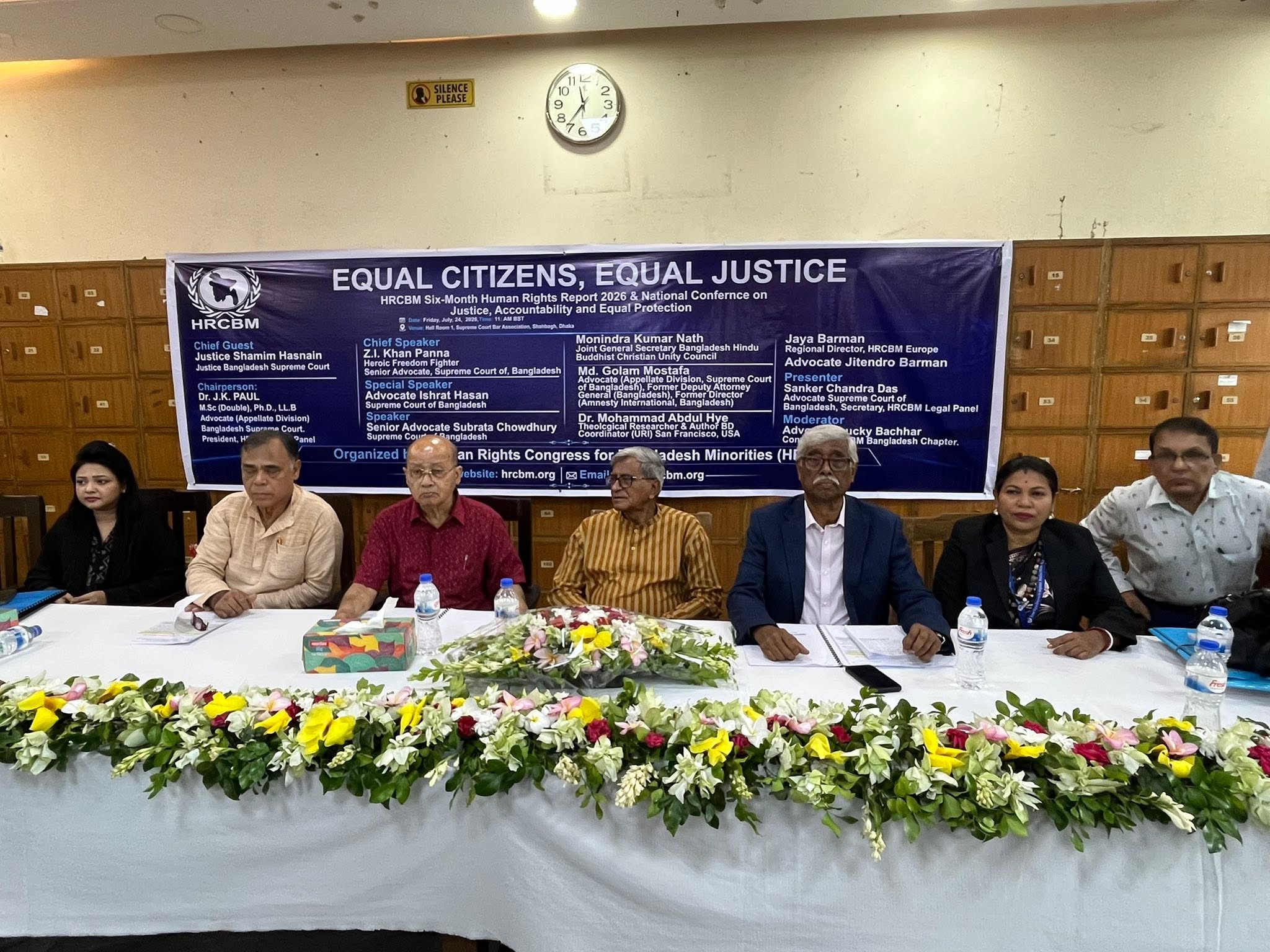
HRCBM presents its Six-Month National Documentation Report at a press conference held at the Bangladesh Supreme Court Bar Association in Dhaka.
824 incidents across 63 districts expose relentless persecution—killings, sexual violence, temple attacks, land seizure and impunity—against minorities.
Human rights cannot be enforced selectively. Bangladesh’s minorities deserve the same protection, justice and dignity the world demands elsewhere.”
— Dhiman Deb Chowdhury, Founder and President, HRCBM
DHAKA, BANGLADESH, July 27, 2026 /EINPresswire.com/ — The Human Rights Congress for Bangladesh Minorities (HRCBM) has released The Persecution Continues: Six-Month National Documentation Report, January–June 2026, following its formal presentation at the Bangladesh Supreme Court Bar Association.
The report documents 824 incidents of
HRCBM recorded 168 murders and mysterious deaths; 223 kidnappings and physical assaults; 41 incidents of sexual violence, rape or gang rape; 141 attacks on temples and other religious institutions; 234 incidents of land grabbing, property dispossession, arson or looting; and 17 blasphemy-related incidents.
Behind these figures are people killed, families shattered, women and children traumatized, places of worship violated, ancestral lands seized, homes destroyed and communities forced to live in fear. HRCBM warns that the geographic reach, severity and recurrence of these incidents reveal not isolated crimes, but a nationwide crisis of persecution, impunity and denial of equal protection.
Successive governments have come and gone, yet the insecurity facing Bangladesh’s minorities has not ended. Killings, assaults, sexual violence, attacks on temples, land seizure, intimidation, weaponized allegations and barriers to justice have continued across political transitions. HRCBM maintains that this cannot be dismissed as a temporary law-and-order problem or attributed solely to one administration. It reflects a persistent failure to prevent attacks, protect vulnerable communities, investigate violations and hold perpetrators accountable.
The pattern raises grave questions about whether the rule of law, constitutional equality and Bangladesh’s international human-rights obligations are being upheld in practice. When victims cannot obtain timely police protection, investigations remain incomplete, evidence is not preserved, witnesses face intimidation and perpetrators expect impunity, legal guarantees become meaningless for vulnerable communities.
HRCBM compiled the report through its incident registry using field investigation, local verification, victim testimony, police complaints, court records, photographic and video evidence, and corroborating media and open-source documentation where available.
The report analyzes recurring patterns, barriers to reporting, delayed or inadequate investigations, alleged impunity, failures of victim protection and the particular vulnerability of women, children, Indigenous peoples and marginalized communities.
Motives in individual cases may be communal, political, economic, criminal or overlapping. HRCBM states that mixed motives do not erase persecution when minority identity, community vulnerability, minority-owned property, places of worship, discriminatory allegations or unequal institutional treatment materially shape the violence, official response or denial of remedy.
HRCBM calls on the Government of Bangladesh to establish an independent and impartial Commission of Inquiry under the Commissions of Inquiry Act, 1956. It should be led by a serving or retired judge of unquestioned integrity and include affected communities, credible human-rights organizations and international observers.
The inquiry should examine violence and dispossession; failures by police, administrators, prosecutors or other institutions; preservation of evidence; protection and remedies for victims and witnesses; and the reforms required to prevent recurrence.
HRCBM urges the international community to reject selective enforcement of human rights. Governments, United Nations bodies and diplomatic missions cannot condemn persecution in some countries while remaining silent when abuses elsewhere are politically inconvenient. Human dignity, freedom of religion or belief, equal protection and accountability are universal obligations—not principles to be applied according to strategic interest.
International silence can embolden perpetrators, deepen institutional denial, isolate victims and signal that minority suffering may be tolerated when geopolitical priorities intervene. HRCBM calls on United Nations mechanisms, governments, diplomatic missions and civil-society institutions to review the evidence, preserve records, protect victims and human-rights defenders, and press for credible accountability and non-recurrence.
Bangladesh’s minority communities cannot be asked to endure another cycle of violence followed by denial, delay and abandonment. The world should not wait for an even greater tragedy before insisting that Bangladesh protect all citizens equally and uphold the rule of law.
**Report:**
*The Persecution Continues: HRCBM Six-Month National Documentation Report, January–June 2026*
https://www.hrcbm.org/wp-new/reports/
**Permanent DOI:**
https://doi.org/10.5281/zenodo.21482232
**HRCBM:**
https://www.hrcbm.org
**About HRCBM**
The Human Rights Congress for Bangladesh Minorities documents violations, supports legal and international advocacy, and promotes justice, equal protection and freedom of religion or belief for Bangladesh’s religious and ethnic minority communities. HRCBM is an NGO in Special Consultative Status with the United Nations Economic and Social Council.

No comments:
Post a Comment