
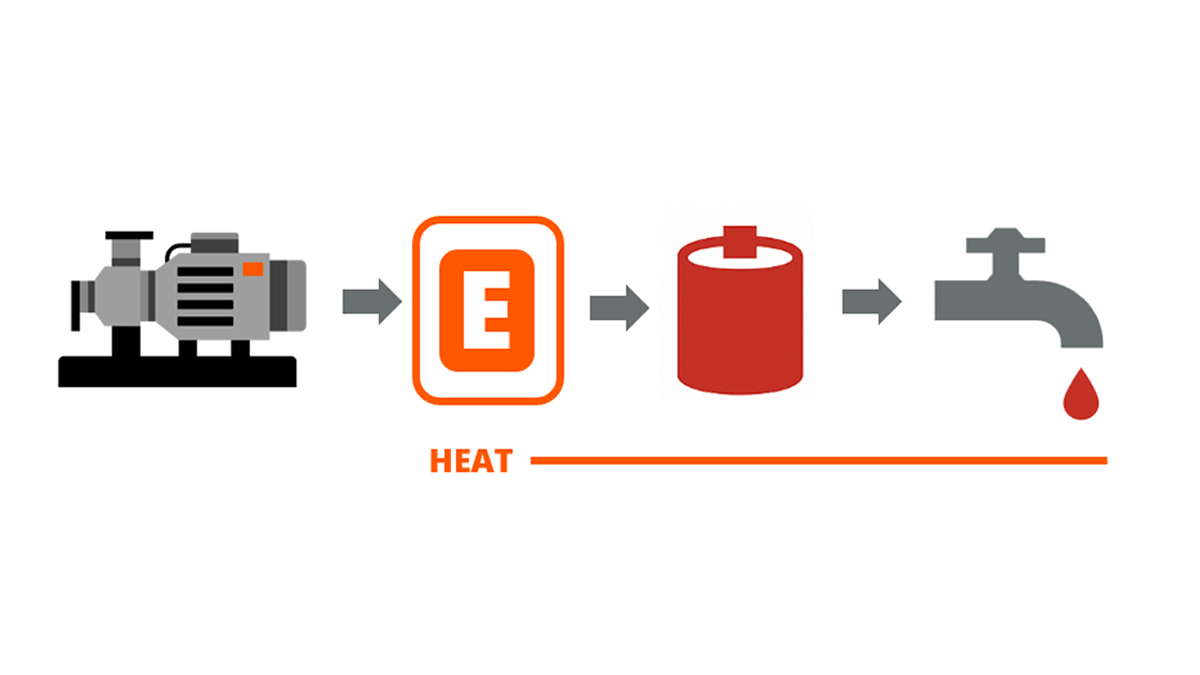
Schematic representation of heat recovery from a vacuum pump, showing thermal energy transfer to a storage unit and reuse via a water supply. Image source: Busch Group.
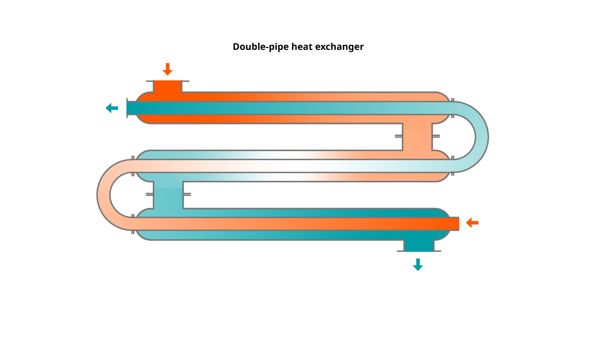
Image 2: Double-pipe heat exchanger with counterflow channels for heat transfer between process fluid streams. Image source: Busch Group.
Heat recovery is the process of capturing waste heat from industrial equipment and repurposing it for another use.
MAULBURG, GERMANY, July 16, 2026 /EINPresswire.com/ -- Vacuum pumps are essential to many manufacturing and processing applications, but they are also a source of heat. While modern vacuum pumps
are efficient and minimize this heat loss, a certain amount of heat generation is a natural by-product of vacuum generation that can never be completely avoided. Traditionally, much of this heat is allowed to dissipate into the surrounding environment.With energy prices rising and sustainability targets becoming more ambitious, finding ways to recover and reuse this heat can significantly reduce energy consumption and offer substantial savings. Heat recovery is not just about improving energy efficiency; it is about turning a by-product of your process into a valuable resource.
What is heat recovery?
Heat recovery is the process of capturing waste heat from industrial equipment and repurposing it for another use. In the case of vacuum systems, this is typically achieved by integrating a cooling system that transfers heat from the vacuum pump into a water circuit. This is typically in the form of a cooling jacket, which surrounds the compression chamber.
The heated water can then be stored or used directly in a variety of ways, such as:
• Heating for production facilities, offices, or workshops.
• Hot water for cleaning and sanitation tasks such as washdowns or sterilization.
• Process heating in manufacturing operations that require warm water.
By capturing this energy before it escapes into the atmosphere, you can reduce the need for separate heating systems, cut utility costs, and lower your carbon footprint.
How heat recovery works
Heat recovery transfers heat from one medium to another, in this case from the heated air generated by the vacuum pump to a liquid. This begins with a cooling jacket.
A cooling jacket is a chamber filled with water or another cooling liquid, such as glycol, which provides a medium for heat transfer. It is integrated into the vacuum pump housing and surrounds the compression chamber. As the vacuum pump operates, the heat it generates is absorbed by the liquid in the jacket. This liquid circulates through the jacket, absorbing the heat the vacuum pump is generating. The heated liquid is then conveyed away from the vacuum pump to be used for other applications.
The secondary benefit: removing excess heat
In workspaces where temperatures must stay constant, the heat released by vacuum pumps into the room must be balanced out. This usually means running air conditioning to remove the extra heat. The cooler the environment must remain, the harder the cooling system must work. This drastically increases energy usage, and therefore energy bills.
By using heat recovery, the amount of heat released into the production area is reduced. This can lead to:
• Lower air conditioning demand in climate-controlled environments.
• More stable ambient temperatures, which help protect heat-sensitive equipment such as electrical controls and support processes where temperature
control is critical - for example, in food production.
How much energy can be recovered?
While exact figures depend on the vacuum pump model in use, operating hours, and heat recovery design, the potential is often significant. For example, a Busch COBRA NX 0650 A (a 650 m3/h dry screw vacuum pump) operating at 1 hPa (mbar) will consume 10 kW of electrical power, 8.5 kW of which can be recovered via its cooling system. If harnessed effectively, this energy could produce thousands of liters of hot water per day.
When calculated over a year, the energy cost savings can result in a relatively fast return on investment, especially in operations with high energy costs or year-round heating demand.
Is heat recovery suitable for my application?
Not every vacuum system will benefit equally from heat recovery. The first step is to assess your needs and resources:
1. Identify potential uses for hot water: This could be for process needs, sanitation, heating, or even pre-heating water for boilers.
2. Assess your demand pattern: Facilities that need hot water throughout the day or year-round will see the best returns.
3. Check your vacuum pump compatibility: Not every vacuum pump is suitable for heat recovery. Some vacuum pumps that are suitable are already
equipped for heat recovery, while others may require retrofit kits.
4. Evaluate space for equipment: You may need an insulated storage tank for hot water, as well as piping for distribution.
Examples of suitable vacuum pump types
Certain vacuum pumps, such as liquid ring vacuum pumps and some dry screw vacuum pumps, are particularly well suited for heat recovery because they already use a water-cooled system, the heat from which can be used elsewhere in the facility. However, a range of other types of vacuum pump can also be adapted for effective heat recovery.
For example:
• Oil-lubricated rotary vane vacuum pumps can sometimes be fitted with retrofit cooling kits to enable water heating.
• Larger vacuum pump models may offer higher heat-recovery potential, but even smaller systems can be worth considering if operating for long
periods.
Practical considerations
When designing a heat recovery system, there are some key factors to keep in mind.
• Temperature control: Systems should include controls to avoid overheating or delivering water at unsafe temperatures.
• Insulation: Both the storage tank and pipework should be insulated to avoid heat loss.
• Integration with existing systems: If your facility already has hot-water generation equipment, the recovered heat can be used to pre-heat water,
reducing the load on your main heating system.
Summary
Heat recovery from vacuum systems turns waste into a resource. By capturing and reusing power that would otherwise be lost as heat, businesses can reduce energy bills, cut emissions, and improve workplace comfort.
Whether used for heating, cleaning, or process requirements: recovered heat can offer a fast return on investment – particularly in energy-intensive industries. With the right equipment and setup, heat recovery can become an integral part of an efficient, sustainable vacuum system.

No comments:
Post a Comment