
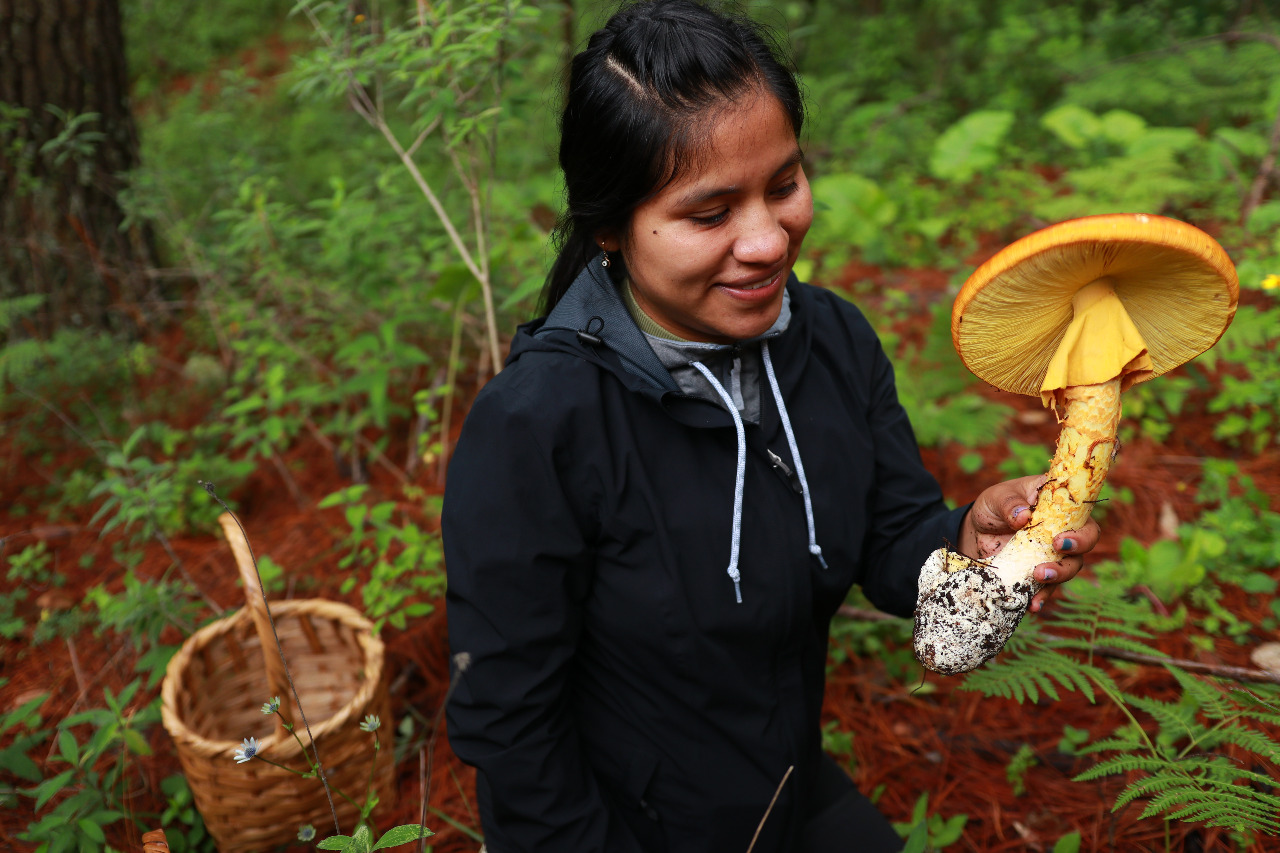
The fungi kingdom as a path to conservation, from forest knowledge for environmental justice and community autonomy.

The project seeks to solve one of the biggest challenges in the Galápagos: protecting biodiversity on a remote island of more than 17,250 hectares, where traditional wildlife monitoring, invasive species control, and ecological monitoring required a different approach.

AQUARESTAURA promotes a comprehensive package of SbN and natural infrastructure, articulating ancestral community wisdom with contemporary innovation.
The 2026 Green Awards finalists bring together solutions from 12 countries that combine science, local knowledge, technology and new production models.
CUENCA, AZUAY, ECUADOR, September 15, 2026 / EINPresswire.com / -- Ancestral systems for water recovery, artificial intelligence applied to conservation, solar mobility in indigenous territories, and
new materials created from waste are among the finalist solutions for the 2026 Green Awards .The initiatives come from 12 countries and show how technology, local knowledge, science and new production models are converging to address the region's environmental and social challenges.
An ancient technology that allows water to be infiltrated into mountains for later retrieval, artificial intelligence capable of analyzing hundreds of thousands of images of wildlife in the Galápagos Islands, drones and satellite data used to anticipate forest fires, and coffee waste transformed into materials for 3D printing and textiles. These are some of the solutions that demonstrate how Latin America is innovating using its own territories, knowledge, and resources.
These initiatives are part of the 52 projects from 12 countries selected as finalists for the 2026 Green Awards , distributed across ten categories related to agriculture and food production, water, resilient cities, human development, circular economy, marine and terrestrial ecosystems, energy, finance and green tech.
Among the finalist projects are diverse forms of environmental innovation that go beyond the development of new technologies. Some initiatives recover ancestral knowledge, others transform waste into new materials, apply science and technology to ecosystem conservation, or integrate communities into new production chains. This diversity of approaches demonstrates how solutions can arise from both technological innovation and the accumulated knowledge of local communities.
In Peru, AQUARESTAURA is restoring ancient Andean water management systems to address water scarcity around Lima. The project rehabilitates amunas, ancestral canals that allow water to infiltrate the mountains for later use, as well as restoring qochas (small reservoirs) and conserving peat bogs.
By 2025, the initiative reports 13 million m³ of water recharge per year, more than 3,900 hectares of recovered ecosystems and benefits for more than a thousand families from six local communities and more than 225,000 people in Lima.
In Oaxaca, Mexico, another project recovers indigenous knowledge about the fungi kingdom to strengthen the biocultural conservation of forests through community research, education and transmission of knowledge among indigenous girls, boys, youth and women.
In the Galápagos Islands, Ecuador, Floreana Island has become the world's first designated Smart Island, dedicated to conservation and ecological restoration. Camera traps, remote sensors, and artificial intelligence allow for the monitoring of invasive species and endemic fauna. In just 100 days, the system collected more than 250,000 images and automatically processed 98% of them, reducing the time and operational effort required for ecological monitoring.
Technology is also appearing on other fronts. In Argentina, Sentinel integrates drones, ground sensors, satellite data, and artificial intelligence to generate early warnings of forest fires; while GeTAU uses technology to geolocate, record, and monitor urban trees.
In Colombia, Biohunters transforms coffee pulp into materials used for 3D printing, plastic manufacturing, and textiles, also incorporating 20 women coffee farmers into its value chain.
The same logic appears in other finalist initiatives: recycled glass converted into new surfaces in Argentina; yerba mate waste and sawdust transformed into biodegradable flower pots; invasive sargassum converted into agricultural inputs in the Dominican Republic; and plastic waste used to build social housing in indigenous communities in Chiapas, Mexico.
“Innovation in Latin America has an extraordinary characteristic: it stems from the ability to connect knowledge, territory, and technology. When science engages with ancestral knowledge, communities, and entrepreneurship, solutions emerge that address specific needs and also have the potential to be replicated in other parts of the world. This is one of our region's greatest assets,” said Gustavo Manrique, president of the Green Awards.
Among the selected initiatives are solar-powered boats developed in collaboration with the Achuar people in the Ecuadorian Amazon, coral restoration systems, new solutions for rescuing food, technologies to reduce the incidental capture of marine species, biofertilizers developed from waste, and financing models designed to promote sustainable agriculture.
The 52 finalist projects come from 12 countries in Latin America and the Caribbean. Ecuador leads the representation with 11 initiatives, followed by Colombia with 10 and Mexico with 7; projects from Argentina, Peru, Bolivia, Chile, Brazil, Costa Rica, Panama, El Salvador, and the Dominican Republic are also participating. The selection reflects solutions developed in large cities, rural areas, indigenous communities, coastal ecosystems, high Andean zones, and Amazonian regions.
About the Green Awards:
The Green Awards is a regional movement that finds, connects, and amplifies the projects and leaders driving sustainable solutions in Latin America and the Caribbean. For over a decade, it has received more than 22,000 projects from 53 countries, establishing itself as one of the most important events for environmental innovation, social impact, and sustainability in the region.
The 2026 edition has the support and participation of UNDP, VGV CORP, AENOR, IOM, ESPOL, ANDOR - BYD, Agua Cielo, LATAM, Banco del Austro, Grupo Vintimilla, Coca-Cola, Indurama, CRISFE, Banco Pichincha, ECOGAL, Artesa, Art Hotels, Tim Ballard Foundation, Graiman - Atenas, Banco Guayaquil, INHAUS and GET, organizations and companies that are integrated into the Green Awards ecosystem and strengthen its capacity for articulation between international organizations, academia, the private sector and actors committed to sustainability.
The Green Awards also boasts an international jury and an Advisory Board comprised of leaders from multilateral organizations, development banks, conservation efforts, academia, the private sector, and international funds. Its model combines an international call for entries, technical curation, capacity-building and acceleration programs, increased visibility, and an international forum that brings together entrepreneurs, businesses, governments, academia, and multilateral organizations, with the goal of connecting solutions, generating opportunities, and scaling their impact.
The 2026 edition will take place from October 19 to 22 in Cuenca , Ecuador, bringing together projects, leaders, organizations and companies around an agenda dedicated to sustainability, innovation and the transformation of the region.

No comments:
Post a Comment