
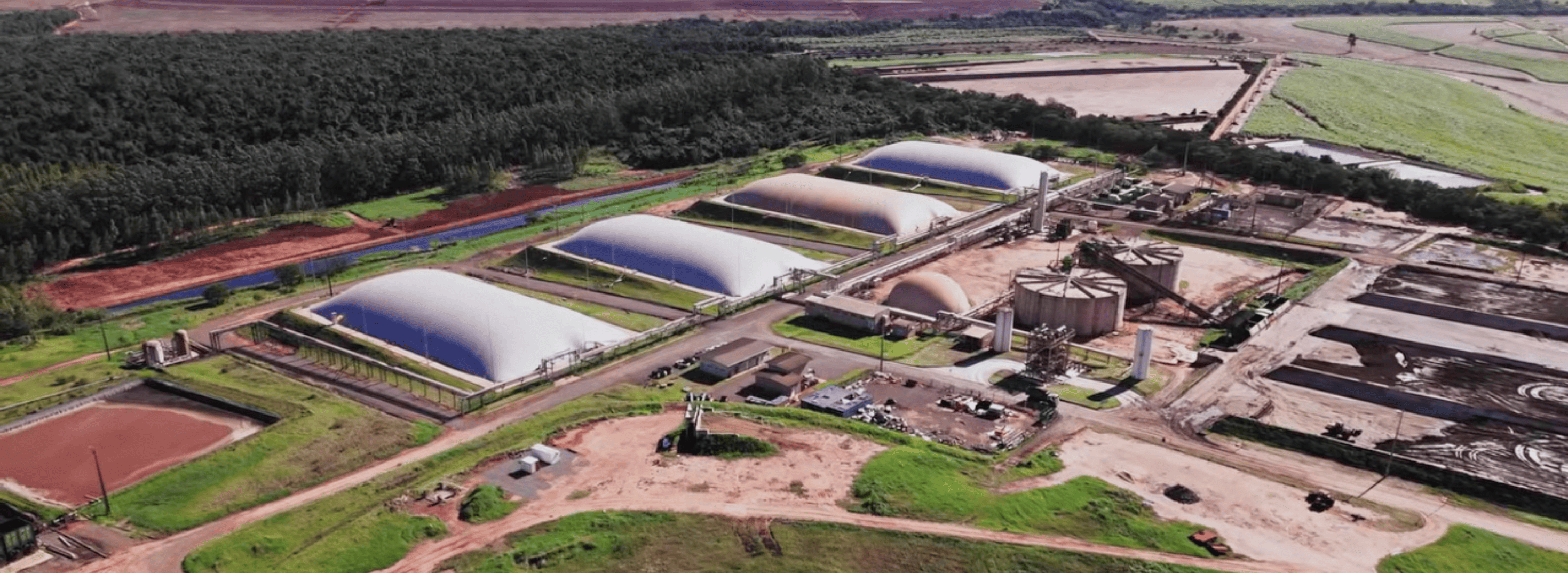
Photo: Cocal/Narandiba Plant. Credit: Esquina.CC
A study commissioned by the MBCBrasil Institute places the country alongside the USA, China, India and Spain in the advancement of renewable fuel for transportation
SãO PAULO, BRAZIL, September 14, 2026 / EINPresswire.com / -- "From Waste to Wheels – Turning Organic Waste into Renewable Fuel for Transport," an international study commissioned by the MBCBrasil Institute, places Brazil among the fastest-growing biomethane markets in the world, alongside the United States, China, India, Spain, Ireland, Austria, and Belgium.
The study analyzes the fuel's progress in nearly 40 countries, which already use it in
Each market has followed a different path. Europe has 1,678 biomethane plants in operation and more than 100,000 industrial facilities that could be adapted for the production of this fuel. China, with a 260,000-kilometer natural gas network, already operates nearly 40 million biodigesters. In the United States, the study counted 470 biomethane projects in 2023, while India has 7.7 million gas-powered vehicles, supported by a natural gas vehicle market of 7.6 billion cubic meters per year. Vehicle manufacturers are already marketing CNG and LNG platforms for passenger vehicles, freight transport, municipal and agricultural applications, while distribution networks using tanker trucks—so-called virtual pipelines—allow the fuel to be delivered to regions that lack physical pipeline infrastructure.
The growth rate is also reflected in projections for Europe, which currently mobilizes approximately 22 billion m³ of biomethane annually. The European Union's goal, under the REPowerEU plan, is to reach 35 billion m³ by 2030. The study projects an increase to approximately 132 billion m³ by 2040, while the sector could reach between 181 and 205 billion m³ annually by 2050.
In Brazil, the scenario combines a still largely untapped resource with an existing industry. Currently, the country has 755 biogas plants and approximately 345 sugar energy plants in operation, but it utilizes less than 2% of the estimated 41.4 billion m³ annual potential for the sugar energy sector alone.
In São Paulo, according to the study, biomethane is already competitive with diesel and could replace approximately 50% of the fossil fuel used in regional freight transport. Starting in 2026, the program established by the Fuel of the Future Law sets targets for reducing greenhouse gas emissions in the natural gas market through incentives for biomethane. The target for 2026 was set at 0.5% and may be gradually increased in subsequent years, up to a maximum of 10%.
Proof that this potential is already becoming a reality can be found at the Cocal plant in Narandiba , São Paulo state, which has been operational since 2020. There, vinasse and filter cake—waste generated during sugarcane processing—feed vertical biodigesters capable of monitoring parameters such as pH and temperature in real time, allowing for a daily production of approximately 50,000 Nm³ of biomethane.
The plant is featured in a new documentary produced by the MBCBrasil Institute, which also showcases the BioRota project and demonstrates, in practice, how waste can be transformed into renewable fuel—precisely the type of solution the study identifies as a path for Brazil to fully realize its potential.
“The study shows that Brazil isn’t trying to catch up with a trend, but rather joining a movement that is already a reality in almost 30 countries. The difference is that few of these markets have the scale of raw materials available that we have in Brazil. Being alongside the United States, China, India, and Spain among the rapidly expanding markets represents recognition of our potential, but also a call to action to take advantage of it,” says José Eduardo Luzzi, Chairman of the Board of Directors of the MBCBrasil Institute.
For Professor Gláucia Mendes Souza of the University of São Paulo (USP), leader of IEA Bioenergy Task 39 and one of the authors of the study, looking at these figures together changes the way the topic is usually debated in the country.
“Biomethane isn’t a one-market bet. It’s already being tested, scaled up, and funded in very different economies, from California to India. Brazil is joining this group with an advantage few countries have: the volume of available agro-industrial waste. And the case of São Paulo demonstrates that this advantage can already be translated into concrete operations,” says the researcher.
About the MBCBrasil Institute
The MBCBrasil Institute is a multi-sector organization dedicated to accelerating the decarbonization of mobility in Brazil. Created through the union of companies, associations, research institutions, and workers, the Institute's mission is to transform technical evidence into public policy and foster sustainable mobility solutions.
Its work focuses on promoting viable decarbonization pathways, advancing bioelectricity technologies, and promoting a just energy transition. Guided by the principle of technological neutrality, the MBCBrasil Institute fosters the integration of biofuels, electrification, and new renewable energy sources, strengthening industry competitiveness and boosting employment, income, and innovation, while positioning Brazil as a global leader in the energy transition.
For more information, visit the MBCBrasil Institute website and follow its activities on LinkedIn and YouTube.

No comments:
Post a Comment