
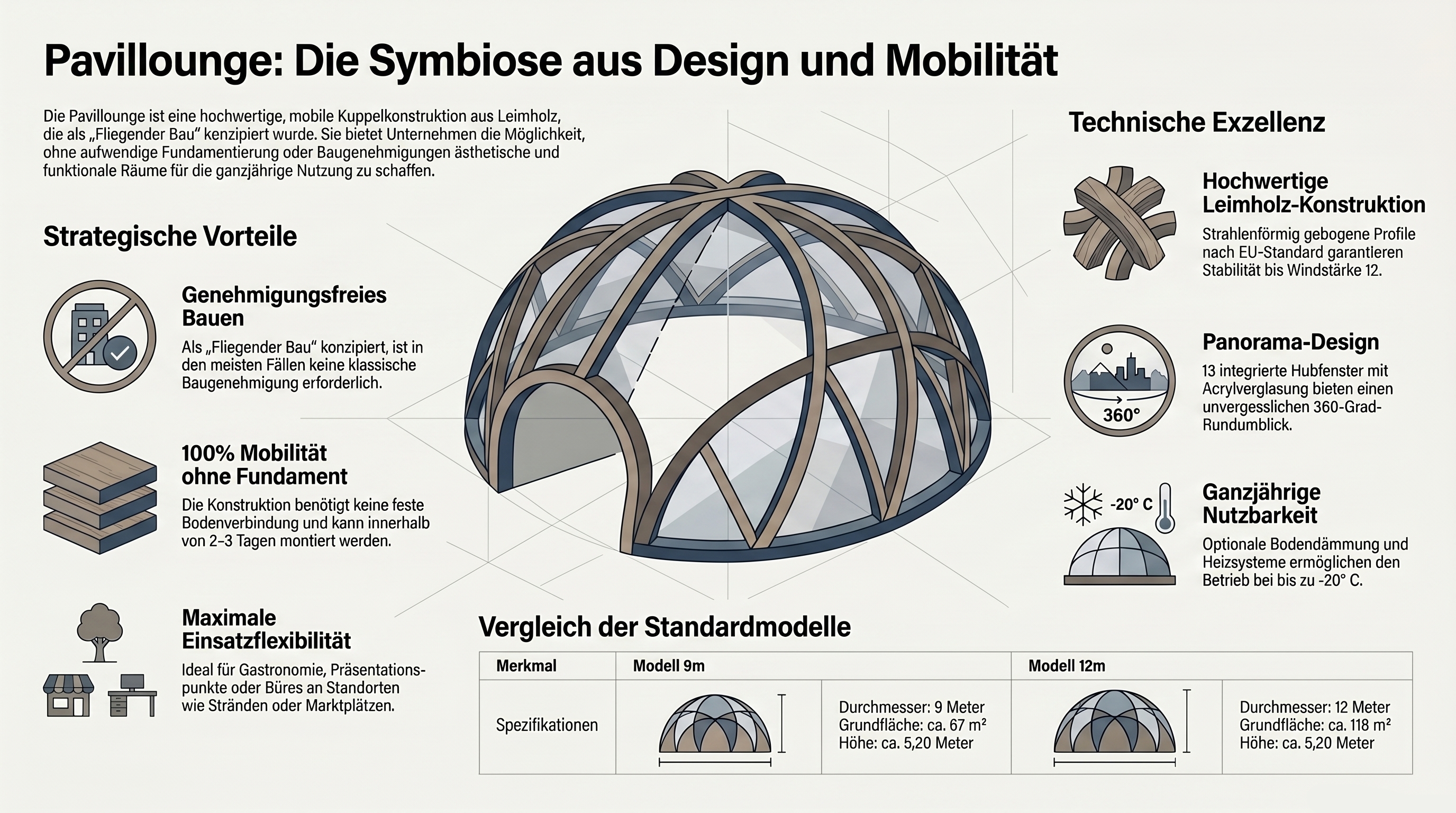
Pavillounge as a mobile dome structure: The infographic shows design, mobility, technical features and standard models with 9 and 12 meter diameters.
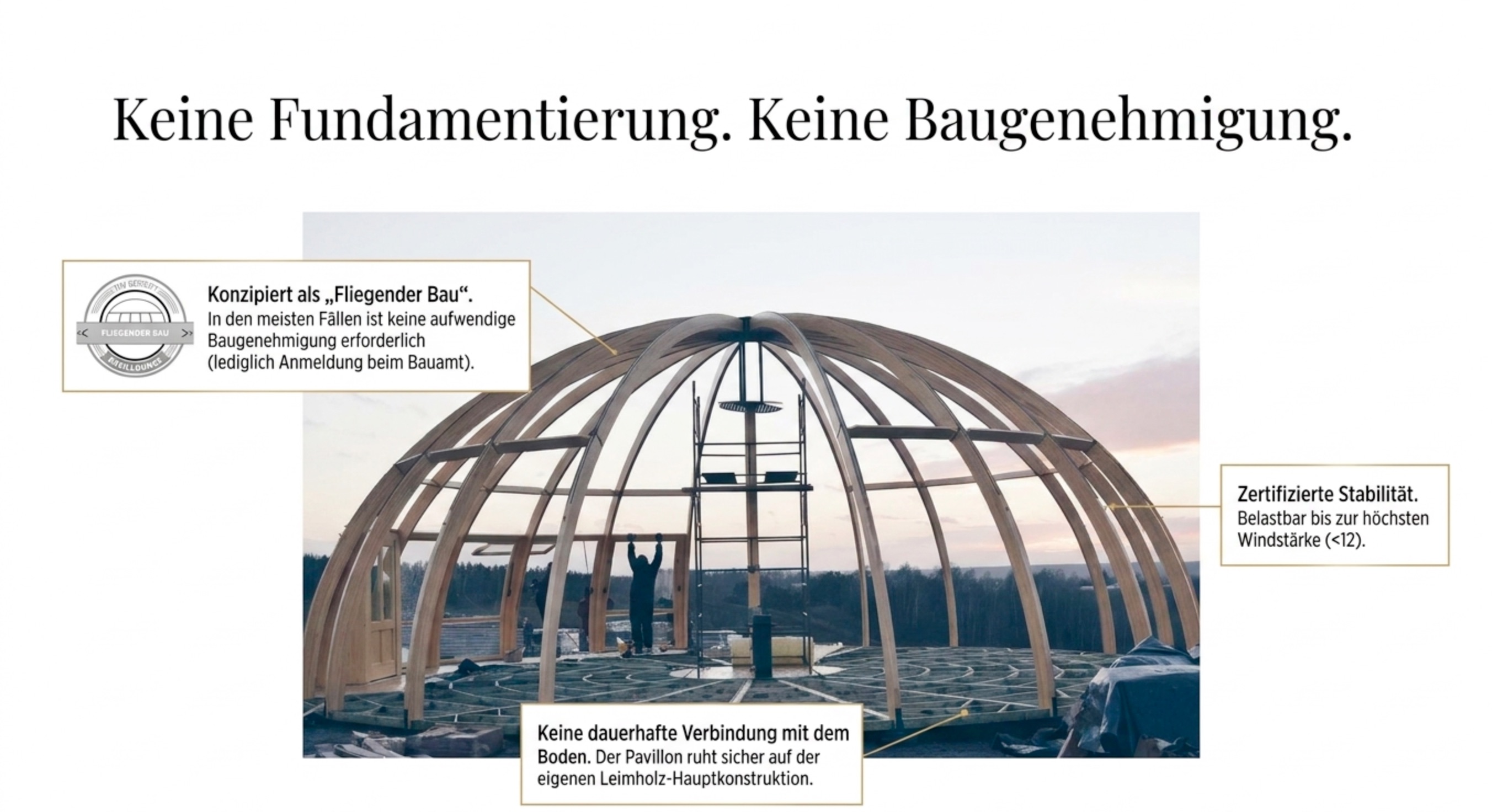
Pavilion lounge without foundation: The mobile glued laminated timber dome structure is designed as a "flying structure" and rests on its own main structure.
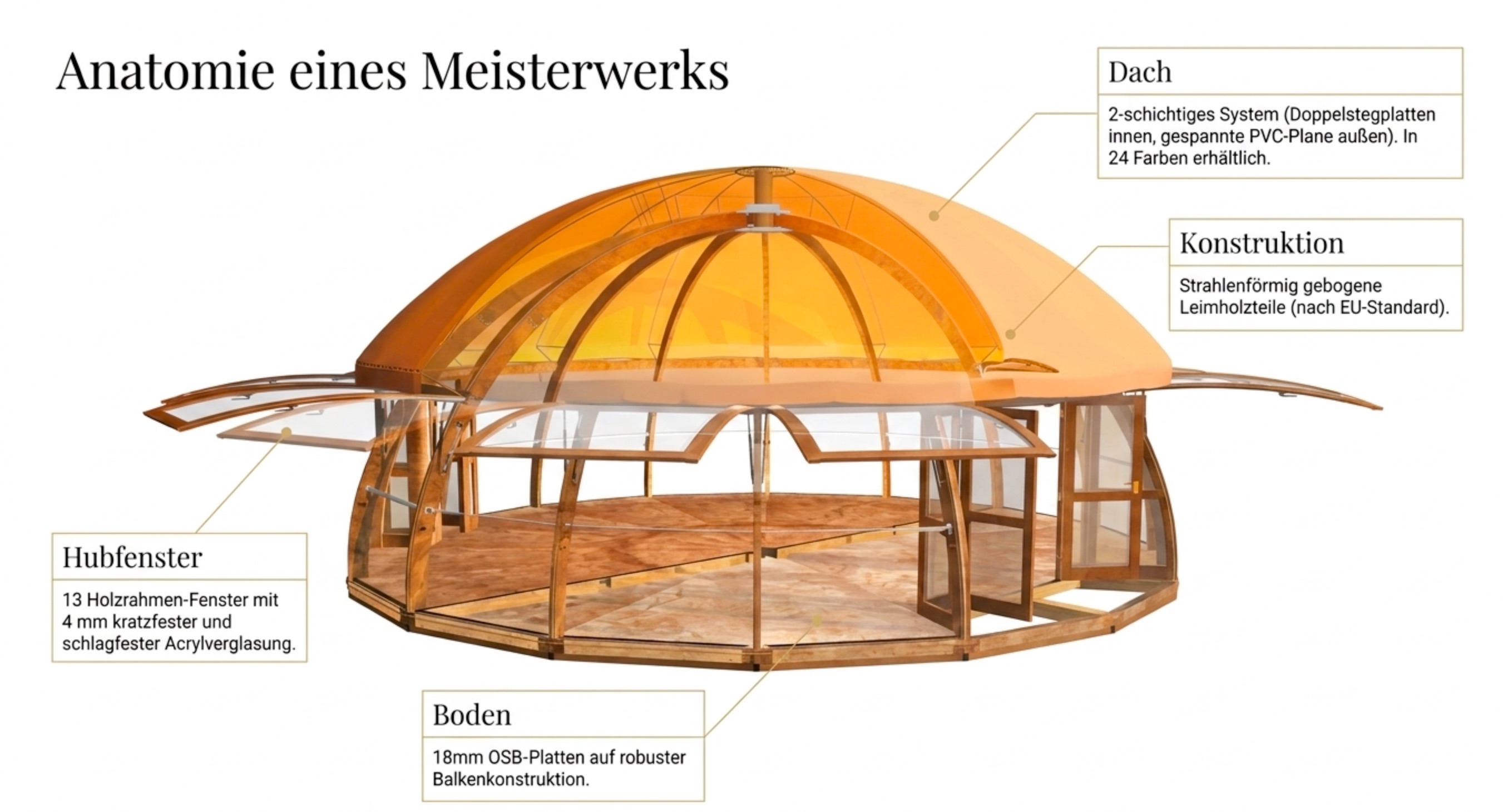
Anatomy of the Pavil Lounge: The graphic shows the roof structure, glued laminated timber construction, lifting windows and floor system of the mobile dome solution.
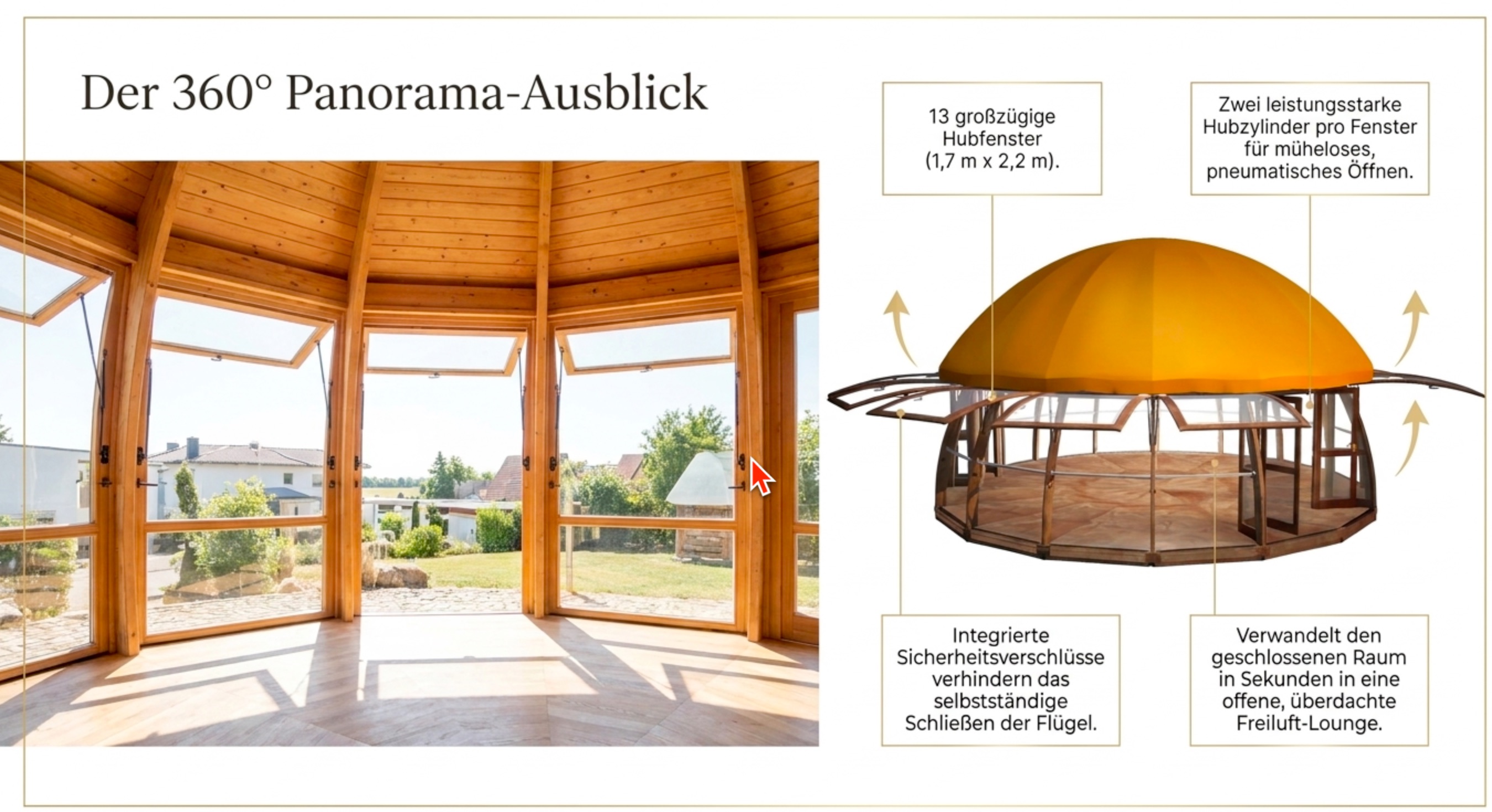
360-degree panoramic view from the pavilion lounge: Generous lifting windows open the enclosed space into a covered open-air lounge in seconds.
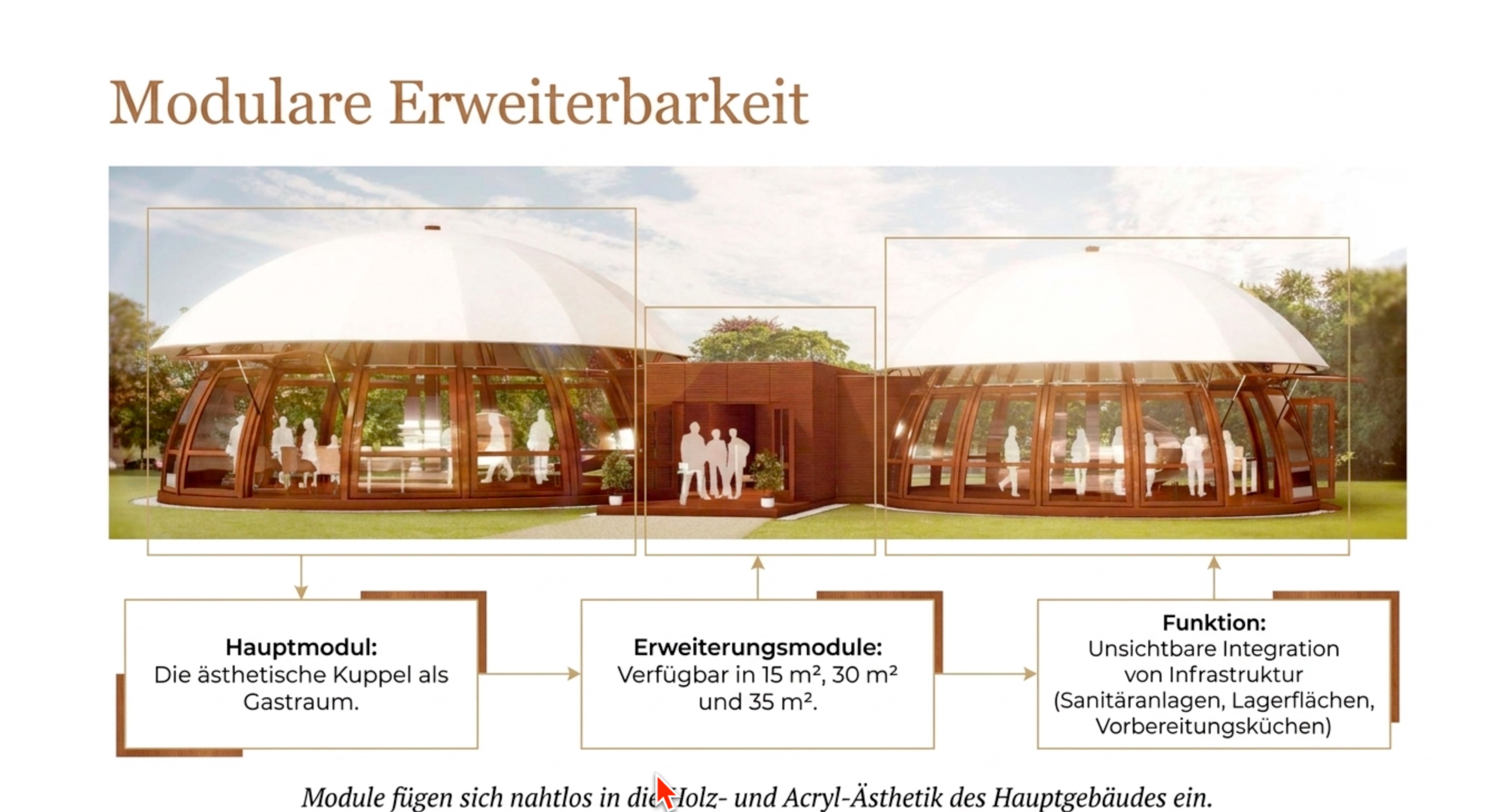
Modular expandability of the pavilion lounge: Main module and extension modules can be combined to create larger room concepts with infrastructure areas.
Pavillounge aims to provide affordable, winter-proof living space on the outskirts of urban centers - modular, quick to assemble and flexible to use.
BERLIN, BRANDENBURG, GERMANY, June 19, 2026 / EINPresswire.com / -- Pavillounge positions winter-proof tiny house solution as affordable housing for metropolitan areas.
The modular space solution aims to create affordable living space in 60 and 120 square
Berlin / DACH region, June 19, 2026 – Affordable housing is one of the most pressing challenges facing many metropolitan areas. In numerous cities, rents, construction costs, land prices, and development costs have been rising for years. Traditional housing construction is often lengthy, expensive, and dependent on complex permitting, financing, and construction processes. At the same time, many peripheral areas, transitional zones, commercial sites, private properties, tourist areas, agricultural land, or areas suitable for temporary use remain unused, even though they could help alleviate pressure on tight housing markets.
Against this backdrop, Pavillounge is being repositioned as a winter-proof, modular housing and tiny house solution. The concept is intended to be attractive not only for restaurants, events, and temporary uses, but also as an affordable, readily available, and high-quality space solution for residential purposes, urban sprawl, employee accommodation, project housing, temporary settlements, and alternative forms of living.
The focus is on two size categories: a compact version of approximately 60 square meters and a larger version of approximately 120 square meters. This places the Pavillounge not in the realm of classic mini-tiny houses, but rather in the category of usable living spaces that can be relevant for singles, couples, small families, employees, site operators, or temporary housing projects.
A key economic advantage is the planned pricing: the Pavillounge is intended to be realized for significantly less than €990 per square meter. This is considerably lower than many conventional new construction costs in residential building. The goal is to offer a solution that makes affordable housing available more quickly without compromising the fundamental requirements of usability, winterization, quality of stay, and modular expandability.
“The housing shortage in metropolitan areas will not be solved solely through traditional new construction projects. We need additional, pragmatic, and affordable spatial concepts that can be used where space is available, but traditional construction would be too slow or too expensive. The Pavillounge can play a role precisely at this intersection: it is winterproof, quick to assemble, modular, and significantly cheaper than many conventional building methods,” says a spokesperson for the Pavillounge project.
The approach is aimed particularly at municipalities, landowners, companies, social service providers, operators of company-owned housing, hotel and tourism businesses, project developers, investors, cooperatives, and private owners who want to make sensible use of available land. The goal is not to replace traditional housing construction. Rather, the Pavillounge is intended as a complementary solution for creating additional living space in the short term and making areas on the outskirts of metropolitan centers economically and socially viable.
One conceivable application is peripheral development. Many metropolitan areas have outer zones where large-scale, traditional housing projects are too complex, too expensive, or politically difficult to implement. At the same time, these areas offer land that could be attractive for modular, reversible, or low-impact housing concepts. These include, for example, plots of land on the edge of industrial parks, expansion areas of businesses, tourist sites, areas adjacent to agriculture, private land, brownfield sites, or temporary development areas.
The Pavillounge relies on a low-impact approach. The solution is modular, quick to assemble, and fundamentally designed for use without traditional, solid foundations. This reduces the impact on the site. However, depending on the location, duration of use, development status, state law, municipal regulations, and planned residential use, it is necessary to examine the applicable building regulations on a case-by-case basis. A blanket statement that no permit is generally required would be irresponsible. The crucial point is that the Pavillounge, as a flexible, low-foundation, and site-friendly solution, can facilitate the review and implementation of specific usage concepts.
Especially with residential use, issues such as development, fire safety, water, wastewater, electricity, heating, thermal insulation, parking spaces, quality of stay, building regulations, and municipal requirements must be clarified early on. The Pavillounge is therefore conceived as a system that opens up new technical and economic possibilities, but should be carefully coordinated with the local requirements of each specific project.
Winter resistance is a key component of this new positioning. Many mobile or temporary space solutions are only usable seasonally or require significant retrofitting if they are to be occupied permanently. In contrast, the Pavillounge is designed as a solution for year-round use. This includes insulating components, protected building envelopes, suitable window and roof systems, heating capability, ventilation concepts and equipment that allows use even at low temperatures.
The smaller version, at approximately 60 square meters, is suitable for one- or two-person households, employee housing, temporary housing projects, operator apartments, long-term tourist use, or compact private living arrangements. The larger version, at approximately 120 square meters, can be an attractive, more fully-fledged housing solution for families, shared apartments, co-living models, social service providers, project teams, or modular housing developments.
This distinguishes the Pavillounge from many classic tiny house concepts, which often offer very small footprints. The goal is not maximum reduction, but affordable living space with sufficient usability. The Pavillounge is designed to be compact, but not cramped. It should appear economical, but not makeshift. It should be readily available, but not seem like a temporary solution.
Another area of application is for companies with a need for skilled workers. Many businesses find employees but then lose them again because affordable housing is lacking nearby. Especially in tourist regions, on the outskirts of metropolitan areas, in the skilled trades, in care facilities, in the hospitality industry, in construction, in industrial parks, and for seasonal businesses, employee housing can be a crucial location factor. Pavilion lounge units could help create living space close to the workplace without having to immediately invest in traditional housing construction.
Social and municipal applications are also conceivable. Municipalities that need to create housing for specific target groups at short notice often face the problem of long construction times and high costs. Modular, winter-proof solutions could help make temporary housing more attractive and dignified. This could include temporary housing options for trainees, students, care workers, seasonal workers, project staff, or people in difficult housing situations.
The price point of significantly less than €990 per square meter is a key element of the discussion. Traditional housing construction costs are considerably higher in many regions. Of course, a direct comparison is only possible to a limited extent because land, development, ancillary costs, furnishings, connections, permits, transport, assembly, and site preparation must also be considered. Nevertheless, the approach shows that alternative spatial solutions can play an important role when it comes to fast and affordable living space expansion.
The Pavillounge can also be of interest to operators who wish to combine multiple units. Modular planning allows for the development of small clusters, residential courtyards, employee villages, temporary settlement structures, or project sites. Communal areas, sanitary and technical modules, storage areas, terraces, pathways, and lounges can be integrated. This creates not just a single building, but a scalable site concept.
This opens up a new perspective for investors and landowners. Areas that are not suitable for traditional project development in the short term could be economically activated through modular residential use. The concept can be attractive for municipalities when examining peripheral locations, transitional areas, or temporary use potential. For private landowners, the Pavillounge can offer a way to create living space for family members, employees, or rental concepts, provided the legal framework permits.
The Pavillounge is marketed via the project websites vr-social.eu/pavillounge and my.kmu.network/pavillounge. These sites present the concept, areas of application, model sizes, basic technical data, and contact information. Interested parties can request an initial assessment to determine whether a Pavillounge would be suitable for their location, available space, and intended use.
This new positioning as a residential space does not mean that previous applications are no longer relevant. Pavillounge remains relevant for restaurants, events, beach clubs, pop-up concepts, and open spaces. However, the additional focus on residential use and winterized tiny house applications significantly expands the market. A temporary premium space solution is evolving into a concept with social relevance: the rapid, flexible, and affordable activation of space to alleviate pressure on tight housing markets.
Because the housing shortage in metropolitan areas cannot be solved with a single measure, complementary models are crucial. Traditional housing construction, densification, conversion, rooftop extensions, serial construction, modular building designs, and temporary solutions can all contribute. Within this mix, the Pavillounge positions itself as a fast, economical, and high-quality option for locations where permanent construction projects are not yet possible, desired, or economically viable.
About Pavillounge:
Pavillounge is a modular, high-quality space solution for residential use, tiny house concepts, gastronomy, events, open spaces, beach clubs, pop-up concepts, and temporary site development. The system combines rapid assembly, modular expandability, winter-proof operation, architectural appeal, and a low-impact design for locations requiring flexible space utilization.
Further information:
https://www.vr-social.eu/pavillounge
https://my.kmu.network/pavillounge

No comments:
Post a Comment